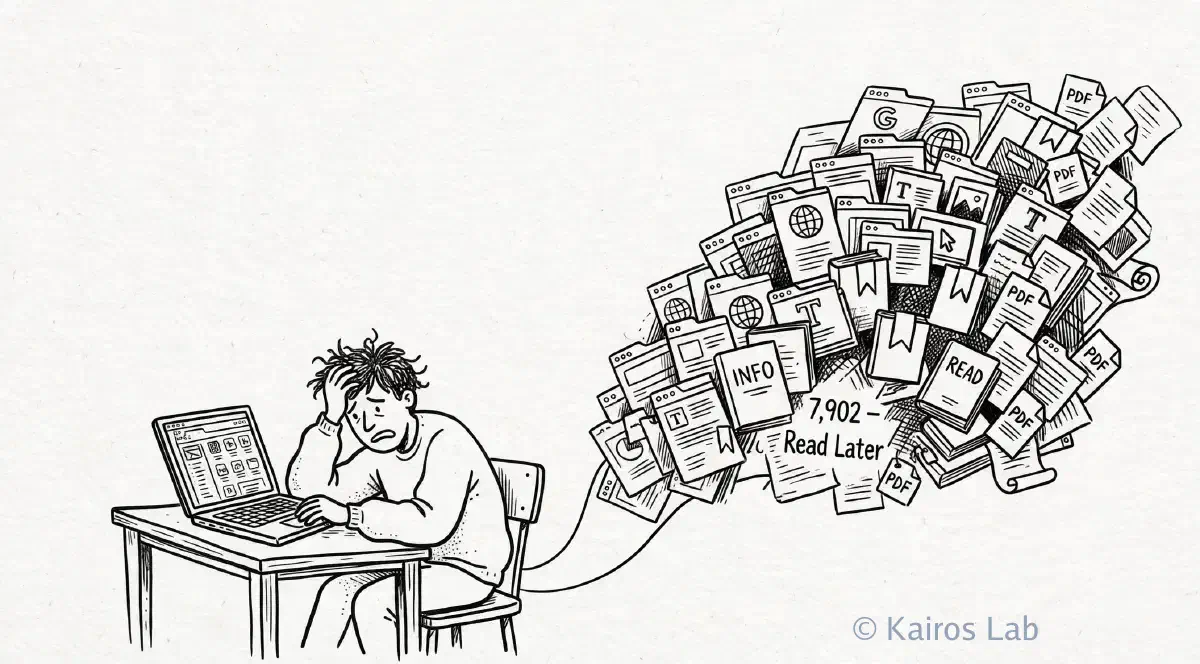
I’ve saved 7,902 articles.
My WeRead is full of highlights. My Cubox sits quietly with clipped web pages. My Zotero is stuffed with English papers I haven’t gotten around to reading. On my phone and my computer, browser tabs stretch out in row after row, and WeChat’s floating windows and Favorites are full of “read later” promises I made to myself.
Every time I hit save, my brain releases a faint hit of dopamine — as if, just by tucking a link into some corner, the knowledge had already synced itself into my head.
But honestly? When I actually need something, I can’t find a single one.
A few days ago I was rushing a draft, halfway through, and I urgently needed a sharp idea I’d read before, as evidence for a point. I clearly remembered saving it — I could even vaguely picture the colors of the article’s illustration. I eagerly opened my collection, typed in a few keywords from memory, and got dozens of completely irrelevant results. I scrolled down the timeline for a full twenty minutes, eyes glazing over, and still didn’t find it.
In the end, so I wouldn’t miss my deadline, I closed the collection, quietly opened a search engine, Googled it again, and found a decent substitute in three minutes.
The moment I closed the page, I looked at the collection icon in the top-right corner of my screen — “1000+” — and it suddenly felt absurd. And in that instant I understood: these 7,902 articles I saved are barely different from not having saved them at all.
They’re like the clothes in my closet with the tags still on — bought because “I’ll wear them someday,” left gathering dust in a corner for a year, and when I actually need to go out to dinner, I still feel like I have nothing to wear.
I used to blame my bad memory, blame myself for being too lazy to regularly “clean up” and “review” my collection. But now I finally see it: the problem isn’t that I’m not diligent enough. My knowledge system was built on the wrong logic from the very start.
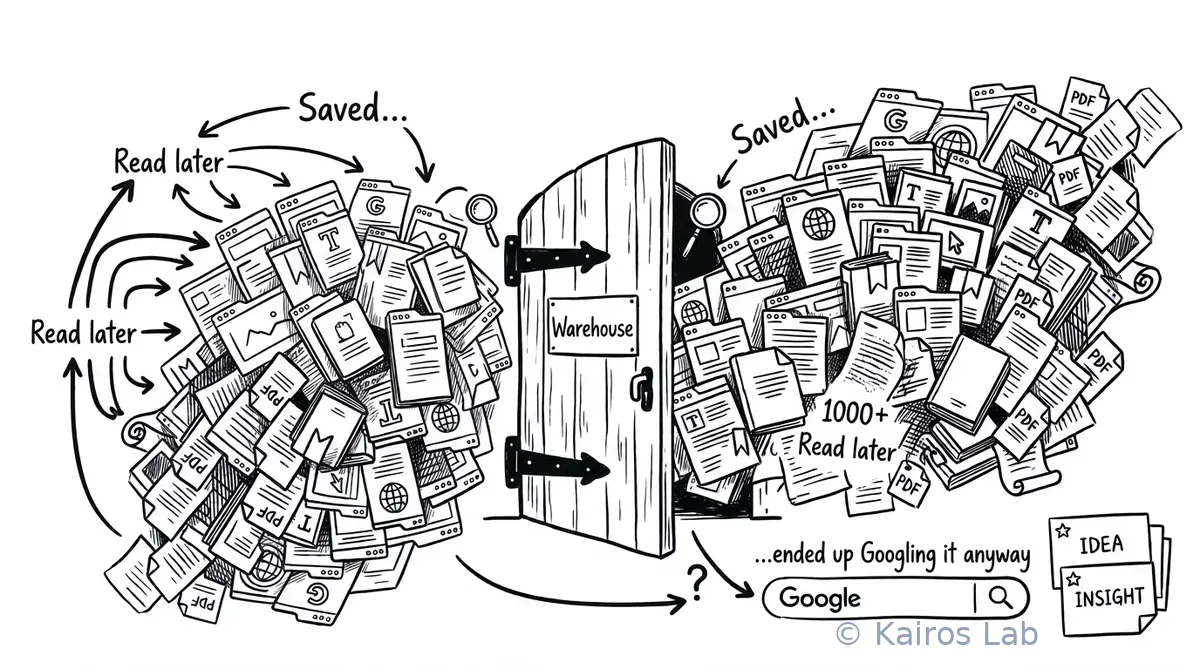
I turned knowledge management into hoarding, and turned the brain — which is meant for thinking — into an inefficient warehouse.
We’re used to replacing “digesting” with “moving.” See a good article, save it on a whim — like hauling bricks into a warehouse, without ever thinking about how to build a wall out of them. Over time the warehouse fills with junk: no index, no categories, until I can’t even remember what’s in there. And when I actually need to build something, facing that messy mountain of stuff, I don’t even have the energy to find a single brick — so I just go buy new ones.
Saving was never the end of reading — it doesn’t even count as the beginning. Information that hasn’t been chewed over, reorganized, and expressed by my own brain is just a string of cold characters sitting on a server. It’s not my knowledge.
Maybe starting today, I should stop this self-congratulatory “digital hoarding.” Instead of piling up 7,902 “read later” items in my collection, I should start now and write down 10 things I truly understand, in my own words, right now.
My Real Numbers
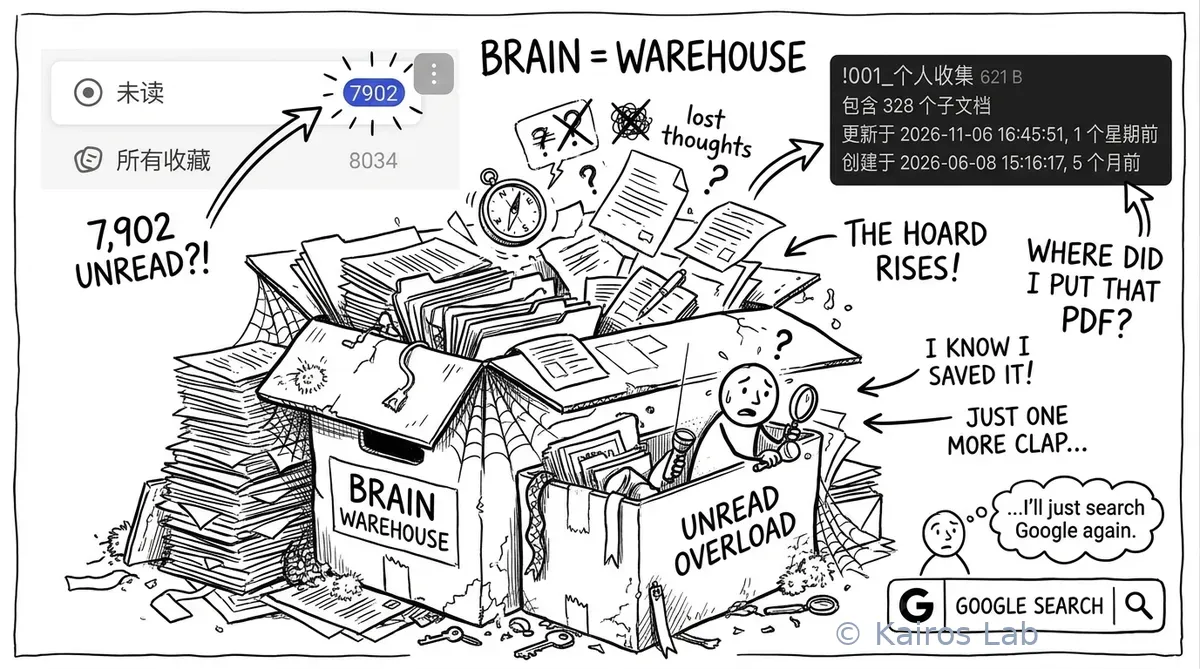
I spent a week counting my own notes.
My note system has 621 notes in total:
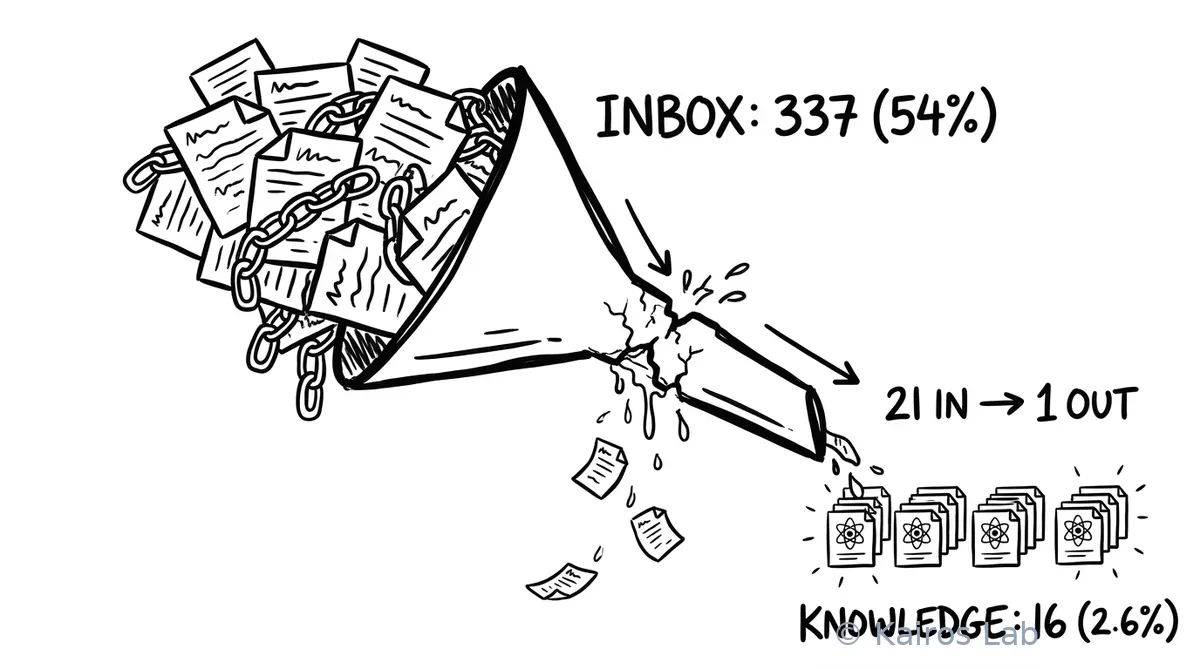
- Inbox: 337 (54%)
- Areas: 151
- Projects: 101
- Knowledge: 16
- Resources: 3
More than half of it is still sitting in the Inbox. Only 16 have actually become knowledge.
337 to 16. In other words, for every 21 articles I save, only one becomes knowledge I can actually use.
I spend the most time collecting and the least time using. This funnel was leaking from the start.
What stings more is that this ratio isn’t an accident — the system designed it that way. Saving takes one click. Processing takes 10 minutes. The cheap action gets done the most; the expensive action gets done the least.
The Inbox isn’t an inbox. It’s a graveyard. Once things go in, there’s no expiry date, no process — they just keep piling up. When I save things I feel like I’m learning, but I’m really just moving stuff — from one place to another.
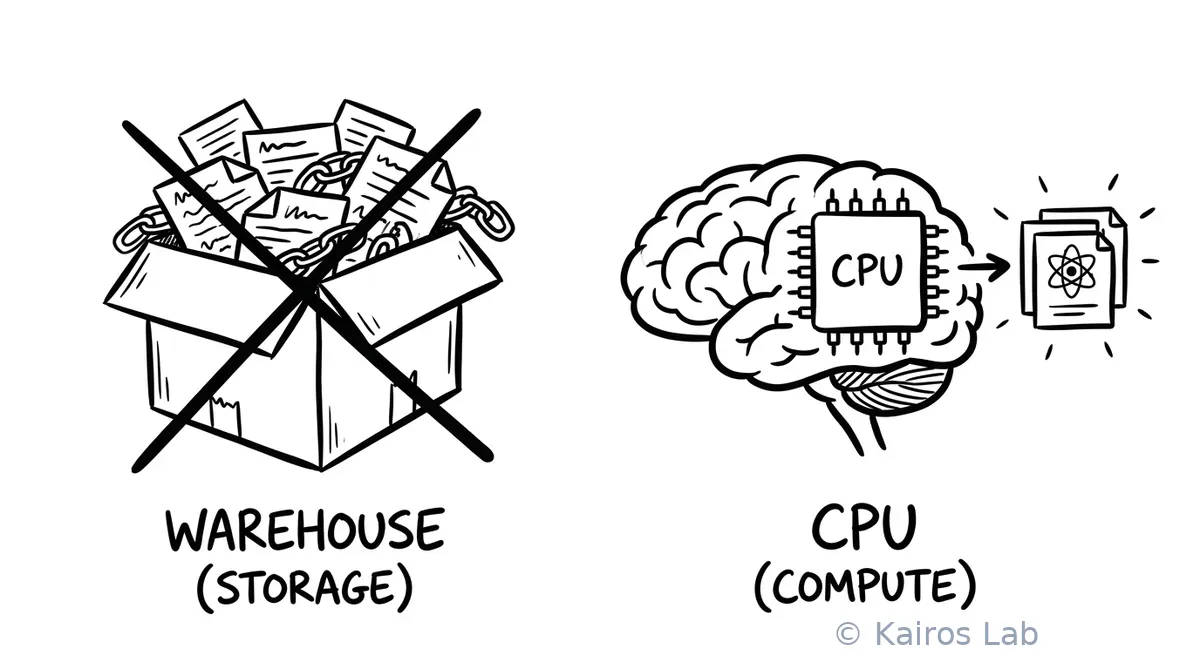
The Brain Isn’t a Warehouse. It’s a CPU.
The problem isn’t you. It’s the process.
I used to think the problem was that I wasn’t disciplined or hardworking enough. I thought if I just tried harder and read a few more saved articles every day, the problem would go away.
Then I realized: the problem was never me. It was the system.
A warehouse is for storing things. A CPU is for computing things. Your collection is a warehouse — the more you pile in, the messier it gets. When you save something you think “this will be useful later,” but “later” never comes, because you have no process for “later.”
The satisfaction of saving is real. You hit save and feel “I’ve got this one.” But what you’ve got is a link, not a piece of knowledge. Saving without a processing step is just piling things up in a different place.
Knowledge management isn’t about being tidy. The measure isn’t how much you stored — it’s how much you used.
After something comes in, nothing tells you: should this be deleted, stored, or turned into a card? That missing step is called “processing.” Without processing, your collection is just a bigger, messier warehouse.
Why does “later” never come? Because “later” has no place in your system. No deadline, no reminder, no fixed time slot. When you save something you think “I’ll read it when I have time,” but “having time” never happens on its own. Without a process, “later” is just a word you use to comfort yourself.
10 Minutes a Day, Just Four Things
So I set myself a new rule — just one sentence:
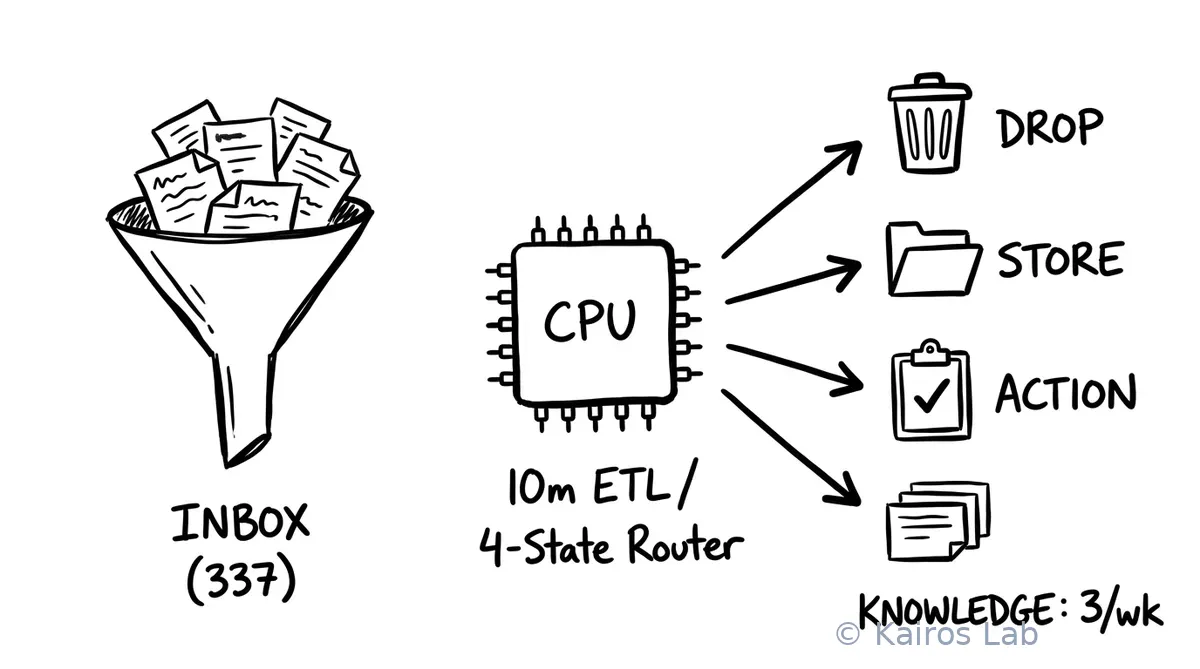
Everything you take in goes to the Inbox. Processing means just four things. Output is measured in permanent cards. Review is measured in four numbers.
How does it work? Ten minutes every evening, just four things:
- Delete: 90% of hot takes and duplicates — delete them directly, no mercy. The test is simple: will I still care about this in a month? If not, delete it.
- Store: if I might use it later, it goes into a literature note — not a permanent card. A literature note stores “what this is and where to find it”; a permanent card stores “what I think about it.” Those are two different things. Don’t mix them up.
- Do: if it’s an instruction to act, it goes into a project task — no card of its own. If an article tells you to do something — try a tool, read a doc, change a setting — put it on your task list. Cards hold ideas, not to-dos.
- Transform: if it sparks an idea, write it as a permanent card. This is the only step that creates a card. Say you read an idea, it reminds you of something else, or you disagree with the author — write that thought down, and that’s a card.
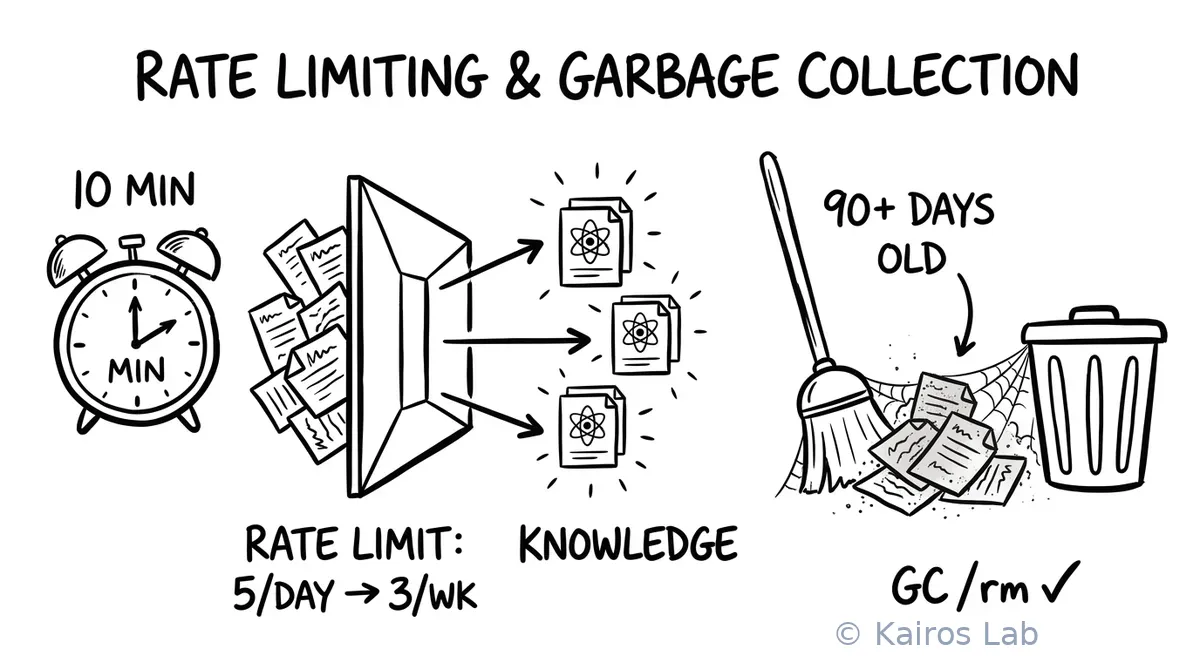
Process just 5 articles a day, and produce just 3 permanent cards a week. No idea, no card — never force it.
These 10 minutes go in the evening. The daytime is for input; the evening is for processing. Open the Inbox, start from the top, pick one of the four — delete, store, do, transform — and stop after 5. No more, no need to be perfect. When you’re done, close it.
The quota is deliberate. Processing only 5 a day forces you to choose — you can’t do them all, so you can only do the best. Producing only 3 cards a week forces you to be picky — not every article deserves to become a card. Out of 35 articles a week, only 3 become cards. That ratio IS the filter.
This Episode’s 3 Permanent Cards
- Saving ≠ owning: the satisfaction of saving is not the same as learning. Saving without a process is just piling things up somewhere else.
- The brain isn’t a warehouse. It’s a CPU: a warehouse stores things; a CPU computes things. A second brain’s value isn’t in how much it stores, but in how much gets used.
- Everything in goes to the Inbox. Processing is just four things. Output is permanent cards: 10 minutes a day, 5 articles processed, 3 permanent cards a week — that’s the smallest complete loop.
One Small Thing You Can Do Today
Open your collection and count: how many items haven’t you opened in over 3 months?
Delete 10 of them. Just 10.
After deleting them, you’ll find you’ve lost nothing — and you feel a little lighter.
Next time, I’ll show how my Inbox started shrinking from 337 — and what the 15-minute daily loop actually looks like.
I’m Lee Kairos, an engineer building my second brain in public. Methods on Tuesdays, real progress on Fridays.